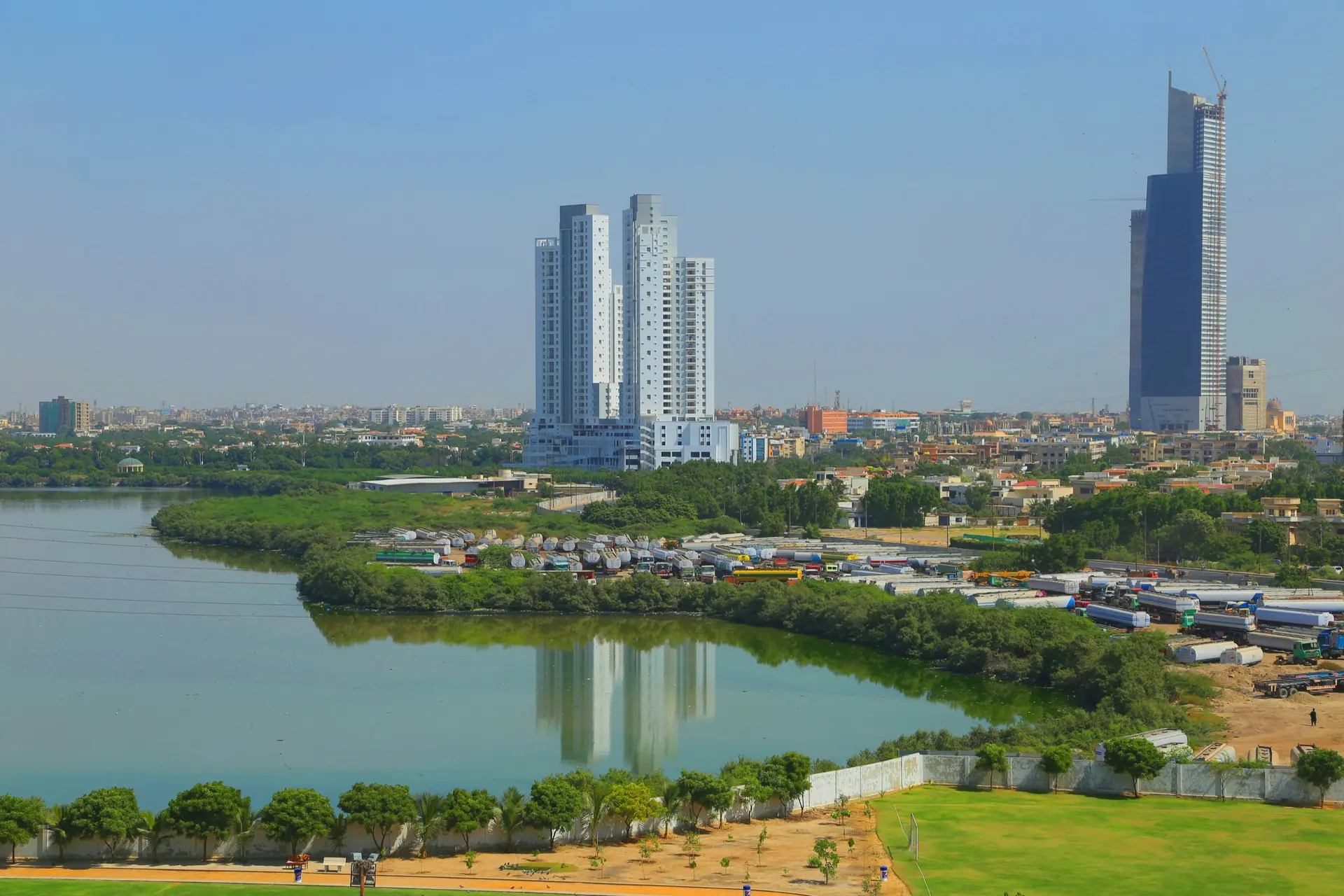
The air gets you first. Warm, salted, thick with diesel off the container traffic leaving the port. Then the horns, and they don't stop while you're here. This is the biggest city in the country and the harbour nearly all its trade moves through. It runs on cargo and appetite, and nobody's curious about whether you're enjoying yourself.
Most people land at Jinnah International and get straight onto something else. Wrong call. Two days here buys you a Victorian commercial district, a working harbour you can get out onto, and the best eating in Pakistan.
What's worth your time
Mohatta Palace first: a Marwari trader's sea house from 1927, Mughal revival, pink Jodhpur stone on local yellow Gizri. It's a museum with rotating shows now, so check what's on, but go for the building.
Frere Hall holds the best thing indoors here, and most visitors never climb the stairs to it. Sadequain spent his last months on that ceiling, a piece called Arz-o-Samawat, and died before finishing. You can see where he stopped.
Mazar-e-Quaid is white marble and 1960s modernism, completed in 1971, and its plaza has no shade at all. At midday you'll last ten minutes. At dusk, marble warm and the guard changing, you'll see why every school in the country comes.
Walk Saddar on a Sunday with the banks shut. Empress Market anchors it, Victorian Gothic from the 1880s and still a working spice market rather than a monument. I.I. Chundrigar Road runs east through the banking district under heavy stone frontages, the Merewether Clock Tower at the end. St Patrick's Cathedral is a few streets over, Gothic, same decade as the market.
The Abdullah Shah Ghazi shrine sits above the sea in Clifton and Thursday evening is when it's alive. Bag searches, separate entrances by gender. And skip the zoo: years of criticism over its enclosures, all of it earned.
Getting on the water
Clifton and Sea View give you a long urban beach and a grim sea. Don't swim. The water's dirty and people drown there every year. Sea View is an evening rather than a beach: camel handlers, corn sellers, families out for the breeze. Manora is the better half day, a spit of land across the harbour mouth reached by boat from Keamari, and the crossing past the working port is half the point. Lighthouse, St Paul's Church, the wrecked Varun Dev Mandir above a beach. Midweek you'll have it.
Churna Island, a bare rock offshore towards Balochistan, is the only serious diving near the city, out past Mubarak Village then by boat, with decent visibility only in winter. Port Grand and Do Darya, a harbour boardwalk and a seafront restaurant strip, are the curated version: you're buying the sea air, not the cooking.
Where the city eats
Burns Road has been the answer for generations. Nihari, haleem, dahi baray, rabri after. Go at night, and don't order one thing in one place. Biryani is where Karachi picks a fight with the rest of Sindh: the Sindhi version carries potato and dried plum and comes out sour and hot, and the Karachi one is what the country now means when it just says biryani. Our side is the potato.
Bun kebab is the real street food, off a cart. Fried patty, egg cracked over it, chutney, bun pressed on the griddle. Nihari is a breakfast whatever the tourist menus claim. For fish, go to the harbour off Keamari and pick off the ice. Bohri and Memon cooking is what visitors miss: the thaal is communal, one round tray eaten in a fixed order, and kitchens around Bohri Bazaar in Saddar serve it. Memon food is home food, so you need an invitation. Late on, the city moves to Boat Basin and Khadda Market, which is where you should be rather than a hotel buffet.
Sindh, out of the city
One long day east stacks four sites together. It's long. Leave before light. Chaukhandi first: sandstone tombs from the fifteenth to eighteenth centuries, carved so finely the stone reads like cloth. Half an hour, worth the stop. Then Bhambore, a ruined ancient port on the creek, usually identified with the Debal the Arab expedition took in the eighth century.
Thatta is why you came out. The Shah Jahan Mosque is seventeenth century, tiled blue and white, with acoustics that carry a speaking voice across the courtyard. Above the town is Makli, inscribed by UNESCO in 1981, tombs running for kilometres along the ridge. Give it hours. Take water and a hat, because there's no shade. Keenjhar Lake past Thatta is the country's second largest freshwater lake and a picnic spot, litter and all. Add it if the light holds.
Hyderabad is an overnight rather than a day trip: Pacco Qillo, the Sindh Museum, the bangle market, wind catchers on the old rooftops. Mohenjo-daro isn't a day trip either, and we'd rather say so now than have you learn it at nine at night on the road back. It's far up the Indus near Larkana, inscribed by UNESCO in 1980, and worth its own trip. Sehwan Sharif, further along the Indus Highway, holds the shrine of Lal Shahbaz Qalandar, and the dhamaal at dusk has no equal. It was bombed in 2017 and security since is heavy, so read our safety page first.
Where to base yourself
Clifton, and it isn't close. Near the sea, near Mohatta Palace and the shrine, walking distance of Boat Basin and Khadda Market, so you can eat without ordering a car. DHA is newer and quieter, with the better modern restaurants, and it puts the colonial core a long drive away.
Saddar puts you on foot from Empress Market, Frere Hall, the cathedral and the clock tower, and the beds are cheapest. It's loud and grubby, and what you'll be told about walking there after dark depends on who you ask. Right if you came for the buildings. The airport hotels are only for a dawn flight.
When to come
November to February, with December and January the pick. The sea takes the worst off and the evenings are good. Now the drawbacks, flatly. Summer isn't dry heat, it's humidity, and from May you're damp by breakfast. The monsoon lands in July and August and the drainage can't take it: streets flood, underpasses fill, the power goes.
Then traffic, which eats more of your day than you've budgeted. Two places that look adjacent on a map can be most of a morning apart. Pick two areas a day, not a list of sights. The trip cost page has the bands.
Getting in and getting around
Jinnah International is the main long-haul gateway into Pakistan, easiest of any airport here to reach from the Gulf, and connected to everywhere domestic. Careem has pulled out of Pakistan, so the apps now are inDrive, Yango and Bykea. Bykea is a motorbike: fastest across the city at rush hour, least comfortable thing you'll do all week.
Don't walk between districts. Distances are longer than they look, the pavement gives out, and the heat settles it. Walk inside an area, ride between them. Street advice varies by neighbourhood and by hour, and your hotel reads it better than any rule.
How long, and the first two days
Two full days minimum, three if you want Thatta. Day one, the old city: Saddar on foot in the morning, Empress Market, the cathedral, the clock tower, I.I. Chundrigar, then Frere Hall for the ceiling. Eat. Mohatta Palace late afternoon, Burns Road after dark. Day two, the water: Keamari and the boat to Manora at first light, back for lunch, Mazar-e-Quaid at dusk, then Boat Basin for as long as you stay upright.
Nearby
Gwadar is the other Pakistani coast, west along Makran, with Quetta inland from it. North, Multan is the first city of size up the Indus and Lahore the one most people pair this with.