Islamabad to Naran is 270 km and takes anywhere from six to nine hours. Look at that spread, because it's the road telling you something. Motorway while it lasts, then the grind through Mansehra, then Balakot, and from Balakot you're following the Kunhar upstream all day with nowhere to overtake. Tuesday in June, it's the short number. August Saturday, it's the long one, and we've had it be worse than that.
What you're driving into is green, and that matters more than it sounds. Almost everything written about northern Pakistan is grey rock and ice. Kaghan is pine on both walls, terraced fields on the shelves above the river, and the Kunhar running hard and cold the whole way, tunnelled and tapped for hydropower in places, so you'll pass site traffic and spoil heaps below Naran. This is a Himalayan valley, not a Karakoram one. It looks like somewhere else entirely.
Then there's the queue. At the Saif-ul-Malook turnoff in Naran the jeeps line up nose to tail, drivers calling for seats, families haggling, the street down to one lane that isn't moving. That's the valley at full tilt, and it isn't the story.
Balakot and the lower valley
Balakot is where the mountains start and where the valley's hardest history sits. The earthquake of 8 October 2005 didn't damage this town, it flattened it, and thousands died here, many of them children in school buildings. Geologists put the old site in a red zone and the government planned a replacement town further south. Two decades on that town is still mostly a plan and Balakot has rebuilt itself in concrete exactly where it stood. You'll drive through a busy bazaar and think nothing of it. Slow down anyway.
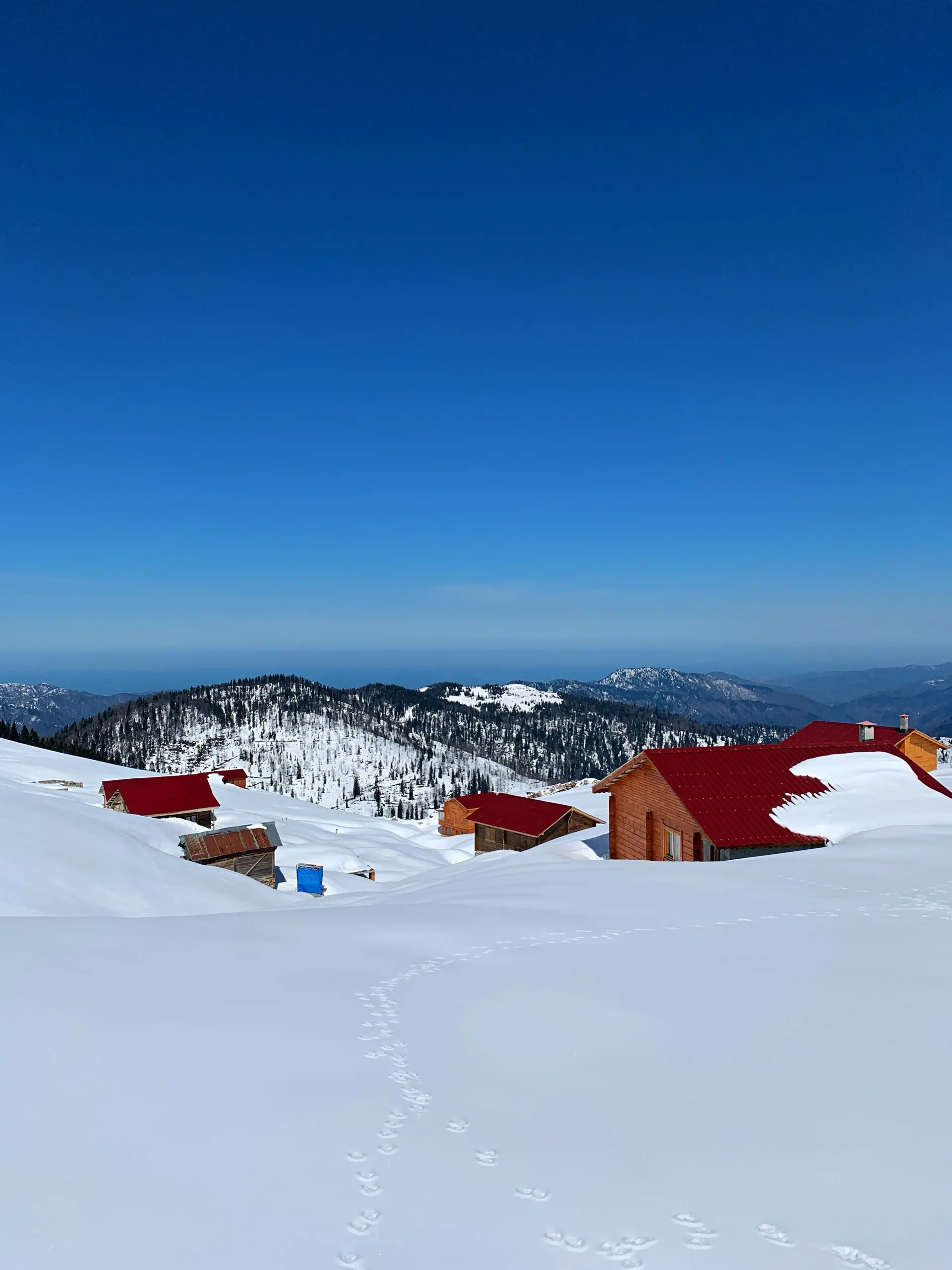
Above Balakot the road reaches Kiwai, where a waterfall drops beside the tarmac and everyone stops for tea and fried fish. The jeep track to Shogran turns off here. Shogran is a plateau of hotels in the pines above the highway: cool, green, no altitude to speak of, and easy on people who won't drive all day. What makes it worth the detour is above it. A rough track climbs again to the Siri Paye meadows, open grass rolling over the ridge with horses on it and Makra Peak across the way, and you can walk onto Makra straight from the grass. The track needs a jeep. People try it in their own cars, and people get towed.
Kaghan village gives the valley its name and is mostly somewhere you pass through. Smaller than Naran, quieter, a few hotels and a bridge.
Naran itself
Naran isn't attractive, and saying so plainly makes the rest of this page make sense. It's a strip of hotels, tyre shops, kebab stands and jeep stands on one street at 2,409 m, thrown up fast and still going up. Nobody comes for the town. You come because everything worth seeing is a short drive from it, and because this is where the beds, the kitchens, the mechanics and the drivers are.
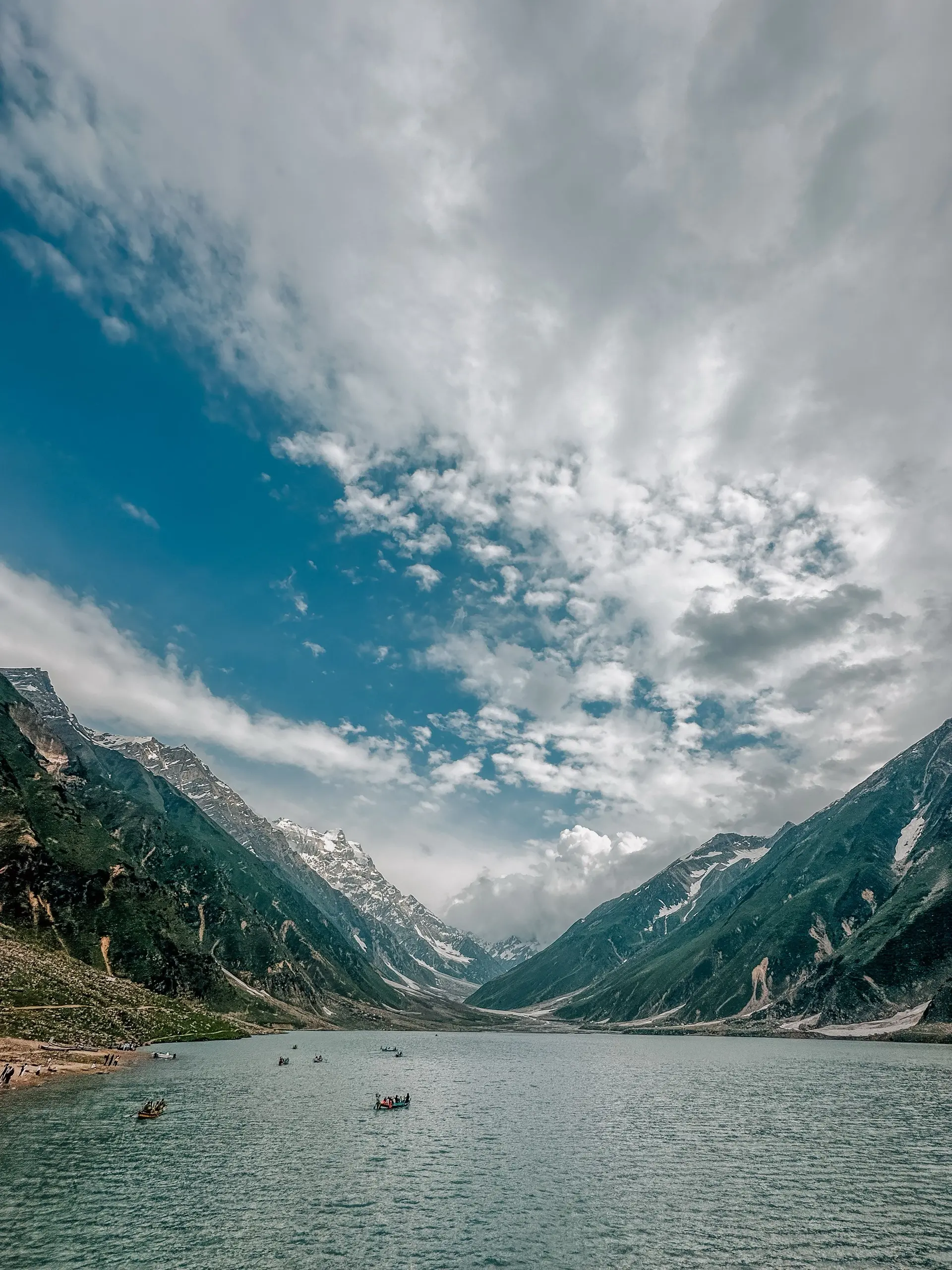
Lake Saif-ul-Malook is why the place looks the way it does. It sits in a cirque above the town with Malika Parbat behind it, and early on a still morning the water holds the whole mountain upside down. Then the jeeps arrive. By mid-morning in August the shore is a market: horse rides, chip vans, boat touts, a crowd two deep at the waterline, and enough litter that you'll see it in your own pictures. Go at first light or don't go. Those are two different places.
Above Naran: Lalazar, Lulusar and Babusar
Past Naran the valley gets better and emptier at once. From Batakundi a jeep track switchbacks up onto Lalazar, a sloping meadow of grass and scattered pine with the peaks laid out in front of it. Same idea as Siri Paye, fewer people. One meadow only? Take this one.
Keep north and the trees give out. Lulusar Lake lies right beside the road, long and dark under a bare ridge, and it's the source of the Kunhar you've followed since Balakot. No walking involved, which is the appeal and the limit both. On a clear day it's the best roadside stop in the valley. On a grey one it's a lay-by with a lake.
Then Besal, tents and tea stalls doubling as the trailhead for Dudipatsar, and then the road turns uphill in earnest for Babusar Top at 4,173 m. Get out and walk away from the parked cars. North of the pass everything changes: the green stops, the ground goes brown and grey, and you're looking down into Gilgit-Baltistan with Nanga Parbat off to the west when the haze allows. No other road in the country switches landscape that fast.
The lakes you have to walk to
Two kinds of lake here, and the difference is the whole trip. Saif-ul-Malook and Lulusar are day-tripper lakes. You arrive by vehicle, you share them, you leave. Dudipatsar and Ansoo are a different holiday, and if you're the sort of traveller who'd otherwise be in Skardu, they're the reason to come to Kaghan at all.
Dudipatsar is the fairer of the two. Start at Besal, follow the stream up a long side valley, climb into a bowl holding green-blue water under snow-streaked rock. A full day with real distance in it and nothing technical anywhere, just length and a climb at the end. Plenty of people split it over two days and sleep at the shepherds' settlement partway up. That's the better version if you can spare it.
Ansoo is the hard one, and people underestimate it because they've seen a photograph. It runs from Saif-ul-Malook over a shoulder below Malika Parbat: a dawn start, a long day, a lot of ascent. Snow sits on the approach well into summer, the line is easy to lose in cloud, and people get into trouble up there every season. Hire a guide in Naran or at the lake. This is somebody's local walk. Use them.
Siri Paye is neither of those. It's a jeep ride and a stroll, and that's a perfectly good day.
One thing nobody warns you about. You can eat breakfast in Islamabad and stand above 4,000 m at Babusar the same evening, and almost nobody's body enjoys that. Headache, no appetite, a broken night. Usually mild, and the fix is boring: sleep low in Naran or below, drink more water than you feel like, and don't put Babusar and Ansoo on the same day.
Where to base yourself
Naran, if the trip is short and you want to see the most. Ugliest of the four and easily the most useful. Everything above and below is a day trip, the jeeps leave from here, and when a plan falls apart you can rebuild it over breakfast. Get a room off the main street or the horns will keep you up.
Shogran, if you're with people who won't tolerate a long drive, or with small children, or if what you want is trees and cool air rather than lakes. You'll be a long way from everything above Naran.
Kaghan, if Naran is full or Naran's noise beats you. Quieter, fewer beds, and you'll drive more each morning. Balakot, only if you're arriving late and leaving early. It's a working town rather than a destination.
When to go, and what's actually open
Weather is the wrong frame here. Access is the right one, because three separate gates control this valley and they don't open together.
The road up from Balakot is the first. Broadly it's a late-May to early-October valley. Outside that the upper road is under snow and the hotels above Kaghan are shut.
The jeep track to Saif-ul-Malook is the second, and it opens later than the main road. It gains height fast and holds snow after Naran itself is clear. Arriving early in the season to find the track still shut is one of the commonest ways to waste a trip here. Ask in Naran before you book a night for the lake.
Babusar is the third, and it changes your itinerary rather than your afternoon. Its season runs roughly late June to late September. It opens to light traffic first and fully around two weeks later, and both get reported as "the pass is open", which is why the question worth asking is open to what. Snow can shut it again mid-season at no notice. Read passes and roads before you build a route over it, and keep the long way round in your back pocket.
September is the best month here and it isn't close. The pass is still open, the lake track is clear, the summer rush has gone home, and the light beats anything you'll get through the August haze.
The crowds, honestly
This is the most popular mountain destination in the country among Pakistanis, and in July and August that stops being an abstraction. More cars than the road was built for. One street in Naran moving at walking pace. Room rates that follow demand rather than any printed list, and beds gone by Friday lunchtime. The litter at Saif-ul-Malook and along the busy stretches of the Kunhar is bad and getting worse. If you want an empty mountain, this is the wrong valley.
Here's the other half, and it isn't a consolation prize. All those domestic visitors have given Kaghan infrastructure the far north doesn't have: more rooms at more levels, kitchens open late, fuel, mechanics, signal in more places, jeeps you can hire on the morning rather than a week out. If something breaks here, somebody close by fixes it. Try that above Skardu.
The practical version. Come midweek, come in September, start early every day, and sleep somewhere you can walk out of rather than drive out of.
Getting in, and getting around
One road in. North from Islamabad through Mansehra, turn up the valley at Balakot, follow the Kunhar. That's the 270 km and the six to nine hours, and the top of that range is what a summer weekend costs you. No airport, no railway, no second line. Public transport reaches Mansehra and Balakot easily and thins fast above them, so most people come up in a car with a driver or their own. Above Naran the surface carries on towards Babusar in decent shape most seasons, but everything off it needs a jeep. Saif-ul-Malook, Siri Paye and Lalazar are all tracks, which is what the stands at Kiwai, Naran and Batakundi are for. Agree the route and how long the driver waits before you set off, not at the top.
Babusar is the back door. Open, and you can drive Naran to Chilas in a day and join the Karakoram Highway north of the worst of it, which is why Naran turns up as the first or last night of so many northern trips. Shut, and the route reverts to the full KKH through Besham and your whole itinerary changes shape.
How long to give it
Three nights. Two and you'll spend both recovering from the drive.
Day one, up from Islamabad with a stop at Kiwai, sleeping at Shogran or pushing on to Naran. Day two, out of Naran before it wakes up, Saif-ul-Malook while the water's flat, back down for lunch, Lalazar in the afternoon. Day three, Besal early and walk to Dudipatsar, or if the pass is open, up to Babusar Top and over the other side.
Add a fourth night for Ansoo and plan a gentle day after it. Naran also works as a single night at either end of a longer northern trip, which is where it sits in the 14-day itinerary.
Nearby
Over the ranges west is Swat, lower and greener again, and the better call if your dates are wrong for Babusar. Beyond it, Chitral. South down the highway, Peshawar. Come over the pass rather than back down the valley and you're halfway to Gilgit and Hunza.