You come across the isthmus and the place arrives in the wrong order. The ridge first: a long flat-topped wall of rock standing out of the water ahead of you, sand falling away on both sides of the road. Then the boats, hundreds of them, painted and crammed against each other. Then Gwadar, low and dusty at the foot of the rock, almost an afterthought.
Everything else on this site points uphill. This points at the sea. Gwadar sits on a hammerhead promontory shoved out into the Arabian Sea and tied back to the mainland by a sandy neck about twelve kilometres long. The rock was an island once. Waves and drifting sand built the neck underneath it and joined it on, and you can still read the whole process from the car window on the way in.
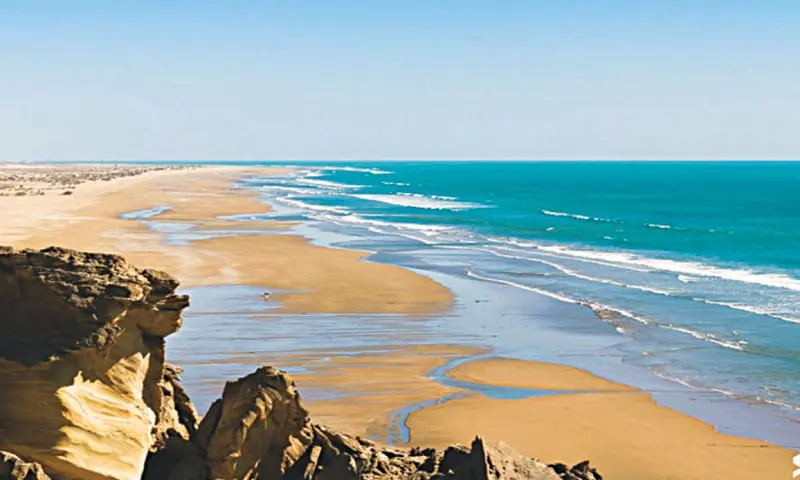
Be honest with yourself about what you're driving all this way for. It isn't the town. The port has been remaking Gwadar for two decades and hasn't finished, so what you get is a working fishing place sitting inside a construction site, with new road alignments, spoil heaps and checkposts where the map says there's nothing. The coast is the reason. Cliffs dropping to sand, beaches running for hours in both directions with nobody's footprints on them, and a road to reach them that outclasses most of what it passes.
The road is the trip
The Makran Coastal Highway, the N-10, runs 653 kilometres from Karachi west to Gwadar and carries on to Jiwani near the Iranian border. Plan around it rather than around the town. It's the only long drive in Pakistan where the sea is on your left the whole way and the mountains on your right are the colour of ash and rust, and if you push it end to end in one go you've thrown most of it away.
Hingol National Park takes up the best of the middle. It's the largest national park in the country and the highway runs straight through it, which is unusual luck: you get the landscape without a permit office or a jeep track between you and it.
Kund Malir is the stop everyone names, and for once the consensus is right. Sit down on it, walk half an hour in either direction, and notice how quickly the other cars stop mattering. This is the one place on the road where you should be prepared to lose two hours you hadn't allocated.
The Princess of Hope and the Balochistan Sphinx are roadside geology, and you'll see them from the driver's seat. Angelina Jolie put the name on the Princess in 2002 and it stuck to a wind-carved mud pillar that looks like a draped figure from exactly one angle and like a lump of mud from every other. The Sphinx is the better of the two and the more convincing. Both are a photo and five minutes, not a stop.
Buzi Pass is where the road climbs off the coastal flat into that mud-hill country. Do the driving here in daylight, and not because of the surface.
Hinglaj Mata, in the gorge on the Hingol river, is the one detour we'd argue for. It's a Shakti Peeth and the largest Hindu pilgrimage in Pakistan, and if you're on the road during the April yatra you'll meet the whole thing coming the other way: trucks, banners, families walking. Outside the yatra it's quiet and you'll be shown around by whoever's there.
Chandragup sits off the highway up a rough track, north of the temple. It's a cluster of mud volcanoes, and the main cone is worshipped as Baba Chandrakup; pilgrims climb it and drop coconuts into the mouth of it before they're considered fit to enter Hinglaj. Grey mud, cold, breathing in slow bubbles. Go if the track and your vehicle agree with each other, and don't attempt it in whatever you rented at the airport.
Ormara, further west, has a hammerhead of its own and a taller one than Gwadar's. Same geology, same story of an island roped to the shore by sand. It's a useful reminder on the way through that Gwadar's shape isn't a freak.
Gwadar itself
Koh-e-Batil is the ridge that forms the hammerhead, and getting up onto it is the single thing to do here. From the top the town resolves into a diagram: East Bay curving away on one side, West Bay on the other, the isthmus a thin pale line running back to the mainland, and open sea on three sides of you. Sunset, obviously. Everyone else has the same idea and it doesn't spoil it.
East Bay and West Bay are the two halves of that diagram at ground level. East Bay is the deep one and the working one, so it's where the port and the harbour infrastructure went. West Bay is shallow, broad and the better beach. Neither is a resort strip and neither is trying to be.
The fishing harbour is where the town actually is, in the sense that matters. Go early, when the boats come in and the auction is running. Alongside it you'll find the boat yards, and this is the part nobody puts in the listicles: men building forty-foot wooden hulls out of imported teak by eye, no plans, no moulds, drilling with a bow drill. Watch for an hour. It earns the hour.
The old town behind the harbour is Omani, not Pakistani, and it looks it. Muscat held Gwadar until 1958, which is well inside living memory here, and the carved doors, the coral-stone walls, the watchtower and the small fort by the bazaar all come from that century rather than from anything in Sindh or Punjab. Much of it is in poor shape and some of it won't survive the next decade of building. See it now.
The port is the reason the town keeps changing shape. You won't tour it and you shouldn't try to photograph it, but you'll feel its effect everywhere: expressway alignments cutting through where people lived, fenced enclaves, a fishing community that will tell you at length what the dredging and the trawlers have done to the catch. If someone offers you that conversation, take it. It's the most interesting thing you'll hear all week.
Astola Island lies roughly twenty-five kilometres offshore and is the largest offshore island Pakistan has. Boats go from Pasni, back down the coast, and the crossing takes a few hours in an open boat with no shade. It was declared the country's first Marine Protected Area in 2017, and the reason is underwater: hard coral, decent visibility in winter, and beaches where green and hawksbill turtles nest. There's nothing on the island. You camp, or you turn around. It's the best diving and snorkelling in the country, and it's also the part of this trip most likely to be cancelled on the morning by the sea state. Build it in as a hope, not as a fixture.
Eating on a fishing coast
This is the one place in Pakistan where you eat fish because it's the obvious thing rather than the brave thing. Inland, seafood has travelled. Here it hasn't travelled at all. What's landing is kingfish, pomfret, mackerel, sardine, prawn, crab and lobster, and the standard treatment is the simplest one: split it, spice it, put it over coals or into hot oil, serve it with roti and raw onion. No sauce hiding anything.
Eat where the fishermen eat, near the harbour, and order whatever came in that morning rather than whatever's written up. The catch has been getting thinner for years, and people will tell you so unprompted. Ask, and take the answer seriously.
The advisory, and the paperwork
Now the part that decides whether any of the above happens.
Several governments advise against all travel, or all but essential travel, to Balochistan, and the wording generally covers the coastal highway as well as the towns along it. This is a materially different position from the one that applies in Gilgit-Baltistan, where most of this site spends its time. Don't carry your assumptions north to south.
That position also moves. Read your own government's current wording, on its own site, dated, before you commit money. Then read your insurance policy, because policies keyed to advisories will void cover for travel into an advise-against zone, sometimes for the whole trip and not just the one leg. Is Pakistan safe sets out how those two documents talk to each other. We're not qualified to give safety or insurance advice and none of this is any.
There's a second layer here that the north doesn't have. Foreign visitors travelling in Balochistan have at various times needed a No Objection Certificate from the authorities, and have been handed a police escort along parts of this road without asking for one. What's required, from whom, and how long it takes has changed repeatedly. Treat it as a question to answer before you book flights, not a rule you can look up here. A registered operator working the route will know the current practice, and tours and treks covers how to find one worth using.
When to go
November to March, and there's no argument to be had about it. The rest of the year this coast is hot and humid in a way that turns a beach into an endurance test by nine in the morning. Winter is also when the sea is calmest, which is what decides whether you get to Astola at all. The monsoon months put boats on the beach.
Getting in, and getting around
You can fly to Gwadar International (GWD). The schedule is thin and it changes, so check what's actually operating rather than what the airport is supposed to become. Flying in gets you the town and the ridge, and it costs you the entire reason to come.
Driving from Karachi along the N-10 is the real answer, with at least one night on the road. Get a driver who has done this route before. Fuel, food and rooms are sparse and unevenly spaced along the highway, and there are long stretches with nothing at all, so you fill up when you can rather than when you need to, and you carry more water than feels sensible. Phone coverage comes and goes. This is not a coast you improvise on, and the failure mode isn't a disappointing afternoon.
How long to give it
Think of it as a road trip with a town at the end, and give it the better part of a week. Two nights on the drive out, two or three in Gwadar with one held in reserve for Astola, and either fly back or drive the road again in the other light. Anything shorter and you're doing the highway in the dark, which removes the point of the highway.
If you only have a few days, don't come. Do the Hingol end as a trip out of Karachi instead and leave Gwadar for when you've got the time to reach it properly. Budget bands for drivers and vehicles are on the trip cost page.
Nearby
North-east inland to Quetta, or back east along the coast to Karachi.