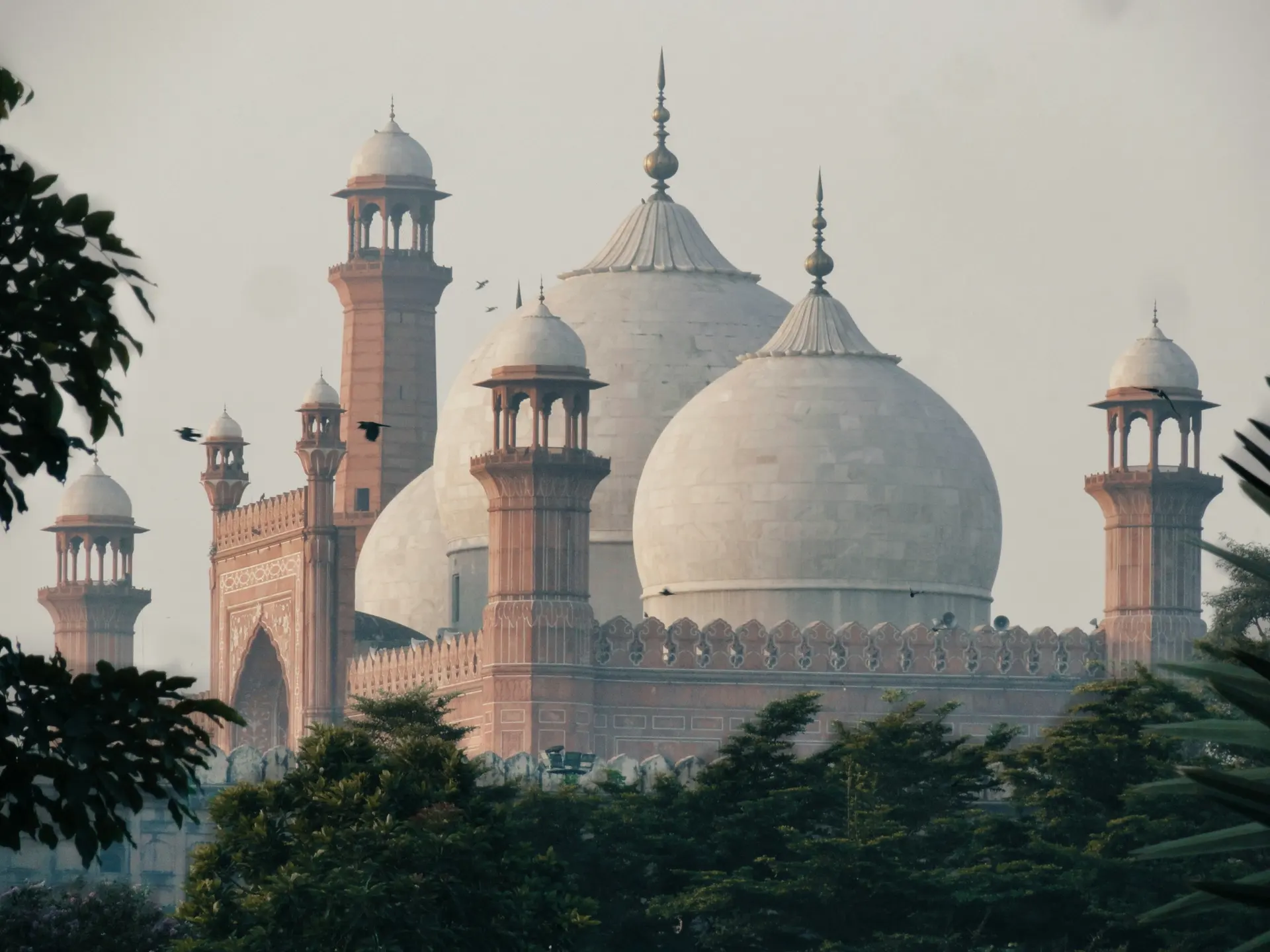
Be standing in Hazuri Bagh when the light goes. The Fort behind you, Badshahi Mosque in front, Iqbal's tomb in the corner under its marble canopy, and for a few minutes every brick surface in view turns the colour of a blood orange. Then the pigeons come off the mosque roof all at once.
The decision to make before you book is how many days. People land, allot a day and a half, spend most of it in traffic and leave annoyed with themselves. Lahore was the Mughal capital under Akbar and what that left isn't a compound you tour in a morning. It's scattered through a city that never stopped working, where the buildings are still in use and still prayed in. Give it three full days. Four if you also want Wagah and the tombs across the river.
The Fort and the mosque
Go to Lahore Fort in the afternoon so you finish at Hazuri Bagh. The Fort and the Shalimar Gardens carry a joint UNESCO inscription from 1981. They went onto the danger list in 2000 and came off it in 2012, and that shows. Some courts are immaculate and some are propped up.
Three things inside earn your time. The Sheesh Mahal, Shah Jahan's mirror hall, where one flame becomes a field of them, on a separate ticket you should buy at the entrance. The Naulakha Pavilion beside it. And the Picture Wall, Jahangir's tiled exterior on the north-west side, which you only see properly from below and outside the walls.
At the ticket window men will attach themselves to you as guides before you've decided you want one. Some are good. Settle it before you go through Alamgiri Gate. Badshahi Mosque is on the other side: Aurangzeb, the 1670s, one of the largest courtyards anywhere. Shoes off, heads covered, and in warm months the marble moves you along fast.
The Walled City
This is the part that stays with you, and the part itineraries underrate.
Come in at Delhi Gate and do the Shahi Hammam first: a Mughal bath house from 1635, small, restored to a standard nothing else here matches, and it tunes your eye for the painted plasterwork ahead. Wazir Khan Mosque is a short walk on, begun in 1634 by the same patron, and its tilework is the single best reason to come to Lahore. Not the scale. The tile: cut mosaic in blues, ochres and greens across the entrance arch and the prayer chamber, calligraphy running through all of it. It photographs badly. If the minaret's open, climb it.
Then stop navigating. The lanes running west toward Bhati Gate are the oldest lived-in part of the city and the only way to use them is to walk with no destination. Be clear on what this is, though. It's a dense residential neighbourhood, not a heritage zone. Motorbikes come through the lane you're photographing, and a tidy old town this isn't.
What earns the time, and what doesn't
Shalimar Gardens. Shah Jahan's terraced garden from the 1640s, on the same UNESCO inscription as the Fort. The hydraulics are largely gone and the GT Road roars past the wall. The terraces still work. Orange Line stop at the gate.
Jahangir's tomb at Shahdara. Across the Ravi, the quietest major Mughal site in the city. Four minarets, no dome, pietra dura over the cenotaph, nobody there. Nur Jahan's tomb nearby is stripped bare, and worth seeing for that.
Data Darbar. The shrine of Ali Hujwiri, an eleventh-century Sufi saint, and the largest of its kind in South Asia. Not a monument visit: a working shrine, screening at the gates, separate sections. Thursday evening the qawwali runs.
Lahore Museum. On The Mall, Zamzama gun outside, building tired and labelling thin. Go for one object: the Fasting Buddha from Gandhara, a starved figure carved so precisely you can count the ribs, in a case with no fuss made about it.
Anarkali, Liberty, Minar-e-Pakistan. The first two are bazaars, not sights. Walk Anarkali in the evening for cloth and noise; skip Liberty unless you're shopping. Minar-e-Pakistan marks the 1940 Lahore Resolution. See it in passing.
Wagah. The daily flag-lowering at the India border, Rangers and BSF stamping and glaring at each other before stadium crowds. Genuinely something, and nationalist theatre performed twice over. Before sunset. Save it for last.
Eating, which is half the reason
Lahore eats better than it builds, and it builds very well.
Nihari first: beef or mutton shank cooked down overnight into a dark, fierce gravy, eaten at breakfast with naan, ginger and lemon. Waris is the name people argue least about. Then paye, the trotter version, richer than you'd want at that hour and correct anyway; Phajja in Gawalmandi is the institution, eaten standing up, early. Karahi after dark, cooked hard in a wok with tomato and green chilli. Butt Karahi at Lakshmi Chowk is plastic chairs on the street and it's the one to try. Kulfi or falooda to finish.
Here's the part guidebooks fudge. Fort Road Food Street was built in 2012 to replace the Gawalmandi food street the government had shut the year before, and it exists for visitors. The rooftops do have the best restaurant view in the country, straight onto the floodlit mosque, and that's what you're paying for. Go once, at night. Old Anarkali and Lakshmi Chowk are where the city eats.
Where to base yourself
Inside the Walled City, around Delhi Gate, there are restored havelis and small guesthouses. You wake up in the thing you came for. The costs are real: noise from before dawn, no lifts, cars that can't reach the door, hot water that comes and goes. It's what we'd choose.
Anarkali and The Mall sits between the museum, the bazaar and the old city, in older hotels with proper rooms. Central, and never quiet.
Gulberg is the sensible answer. Reliable power and hot water, the chains, the best kitchens, and a car ride every time you want a Mughal building. DHA is greener with nothing historic near it, which suits a family visit and is wrong for a short trip. Near the airport is for a late arrival only.
When to come, and what it costs you
November to March, and the reason is blunt. Anything else is too hot.
The drawback is the air. From November into January Lahore is regularly named the most polluted city in the world, and the smog isn't a haze on the horizon. It's a lid. Schools close in the bad weeks, the skyline disappears, and a full day outdoors is a poor idea. Check an air quality app the week before you fly.
February and March are the pick: air clearing, gardens working, evenings that want a jacket. May and June are punishing, a dry heat that makes the middle of the day unusable. July trades that for humidity and flooded streets.
Don't plan around Basant. Lahore's kite festival was banned for roughly two decades after deaths caused by glass-coated string. It came back for three days in February 2026 under safety rules, people died anyway, the ban went straight back on, and the courts have been examining it since.
Getting in and getting around
Allama Iqbal International (LHE) has direct service from the Gulf and a widening list beyond it. It's the practical way into Punjab.
The Orange Line metro is elevated, automated and better than you're expecting. It opened in 2020 and runs right across the city. Two bits matter to you: the Shalamar Garden stop at the garden wall, and the GPO and Lakshmi Chowk stops at the southern edge of the old city. It won't reach Gulberg or DHA.
Use a ride-hailing app for everything else. Walking is right inside the Walled City and nowhere else, where the lanes are too narrow for anything bigger than a motorbike and the density is the whole experience. Outside it, distances are long, pavements come and go, and crossing a main road is a contact sport.
A first two days
Day one is the old city. Delhi Gate early, Shahi Hammam, Wazir Khan Mosque, then the lanes heading west. Eat late. Lahore Fort mid-afternoon, out through Alamgiri Gate, Hazuri Bagh at sunset, Badshahi after, a Fort Road rooftop.
Day two, breakfast in Gawalmandi, then the Lahore Museum and the Fasting Buddha, then Anarkali. Afternoon, the Orange Line to Shalimar Gardens or the river crossing to Shahdara. Data Darbar in the evening if it's a Thursday, karahi at Lakshmi Chowk if it isn't. Day three is Wagah.
Nearby
Islamabad is a straight motorway run north. Multan is further down the Punjab, older than Lahore and built on shrines rather than palaces. If Lahore is one stop of several, the 14-day itinerary shows how it fits, and trip cost has the daily bands.