Start up Trail 3 at first light and the city stops existing within ten minutes of the tarmac. Pines, warm sandstone, monkeys arguing somewhere above your head. Then the trees open and the whole grid lies flat in the haze below you, dead straight and startlingly green. You can be down and eating breakfast before the city has moved.
People treat Islamabad as an airport with hotels attached. We did too, and we were wrong. It isn't a great city; it's a genuinely odd one, drawn on paper in the 1960s, laid out in numbered sectors below a national park, then planted so heavily the trees have won. Nobody gives you a street name here. They give you a sector and a market, and it takes a day before F-6 and G-9 stop sounding like map references. The order costs you something. Islamabad can be sterile, the sectors are too far apart to walk between, and there's no old quarter to get lost in because there was never an old anything. The layers are in Rawalpindi.
What's worth your time
The Margalla trails. Better than anything built here, and it isn't close. Trail 3 starts at the back of F-6 and climbs steadily to the Pir Sohawa ridge road; it's the busiest and the best. Trail 5 is gentler, a good first outing if you've just landed and your legs disagree with you. Go early. By mid-morning on a Sunday you're sharing it with half of Islamabad.
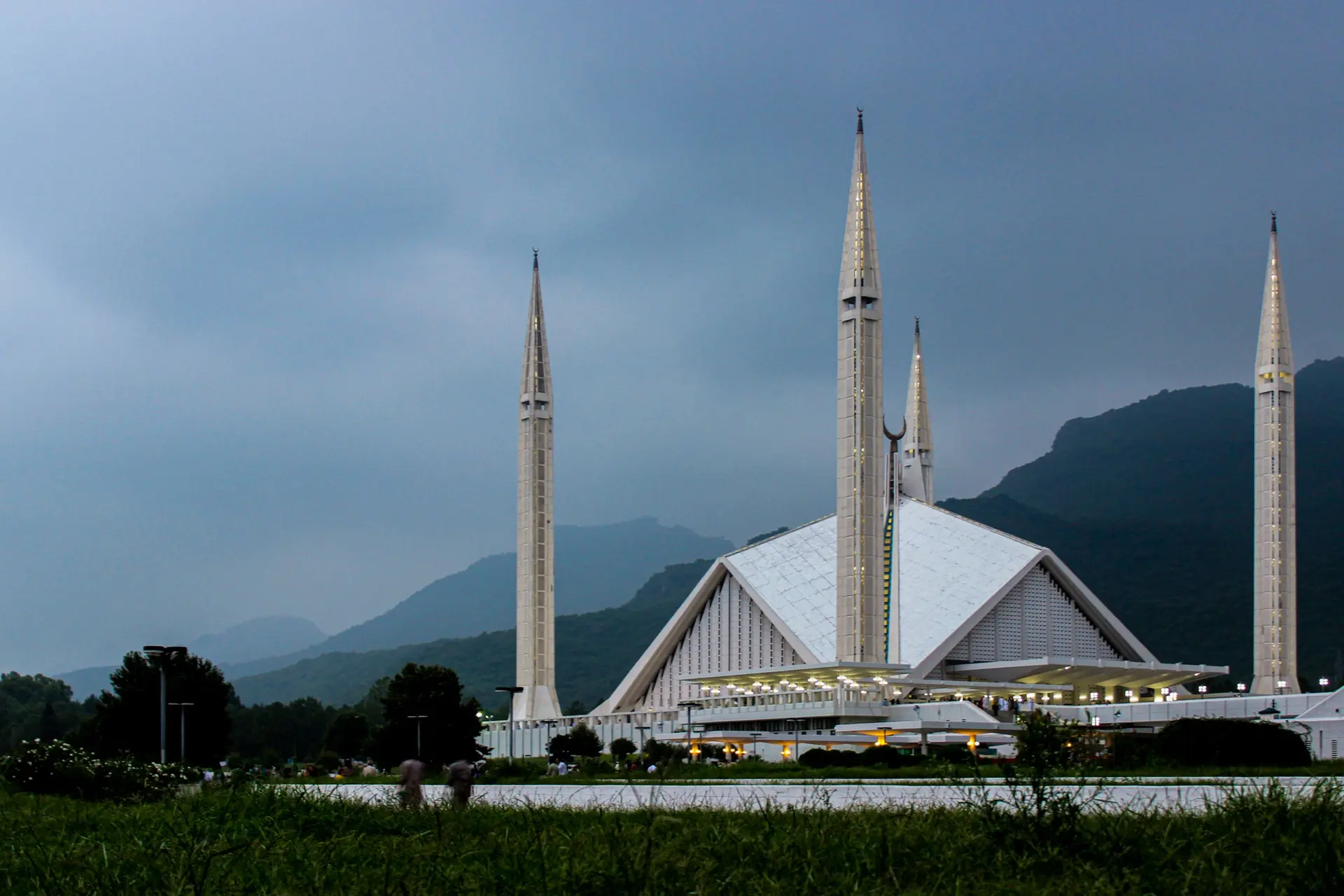
Faisal Mosque. Go, even if mosques usually leave you cold. It sits at the foot of the hills and the roof is the point: a Turkish architect won the competition with a folded tent form instead of a dome, finished in the mid-1980s. From a distance it's geometry parked against the hills. Inside, the scale does the work.
Daman-e-Koh. A terrace viewpoint partway up, with the standard view over the mosque and the grid. Twenty minutes if you're driving past, no more. Above it the road runs on to Pir Sohawa, where the restaurants that made the ridge famous were demolished in 2024 after a court found they had no business inside a national park. Don't drive up counting on a table.
Lok Virsa, the heritage museum on Shakarparian, is the most underrated thing in the city: Kalash dress, Sindhi woodwork, truck art, room-sized reconstructions of village interiors. An hour here changes what you understand about what you see up north. Go before the mountains, not after. The Pakistan Monument shares the hill, four granite petals around a courtyard built in the 2000s, meant to read as the provinces leaning in. Better in photographs than in person.
Saidpur is a Mughal-era village below the hills, restored into a strip of restaurants, with an old Hindu temple and a gurdwara side by side at the top. Heavy-handed restoration. Go for dinner, not for history. Rawal Lake on the eastern edge is worth an hour by the water, and Fatima Jinnah Park fills most of F-9, where the city walks in the evening. Centaurus, at the end of Jinnah Avenue, is the mall everyone navigates by, and after a fortnight in the north you may badly want a cinema. The markets are the street life. Kohsar Market in F-6 is the polished end; the F-6 and F-7 markets behind it are better, with tailors, fruit stalls, a bakery and dinner on plastic chairs. That's your evening, and it costs nothing.
Rawalpindi
Pindi was here first, and it's where the history and the noise live. Islamabad got the trees and the order. They're twenty minutes apart, they run into each other along the Islamabad Highway, and treating them as one city is the best decision you can make with your time. Raja Bazaar is the centre of it, a dense knot of lanes selling cloth, copper, spices and shoes, packed hard enough that you'll abandon any planned route in five minutes. Do abandon it. Saddar, the cantonment quarter the British laid out, reads completely differently: wider streets, colonial-era shopfronts, bookshops, a slow decayed elegance under the signage.
Bhabra Bazaar is the one to make time for. Before 1947 this was a wealthy Jain and Sikh merchant quarter, and the havelis still stand behind the shopfronts, most in poor repair. Look up. Carved doors, overhanging balconies, plaster nobody has touched in eighty years. The lanes around Kartarpura carry the same frontage.
Kartarpura after dark is the best eating in either city and we'll defend that. Nihari, paye, qeema naan, lassi, halwa puri in the small hours for people coming off shifts. Crowded, greasy, and the thing you'll still be describing at home. Ayub National Park on the Jhelum Road is Pindi's back garden, not a sight.
Day trips
Taxila earns a whole day. Not one site but a scatter of them across a valley: the Dharmarajika stupa, the Greek-plan city at Sirkap, the monastery at Jaulian, and a museum of the Gandharan sculpture that came out of the ground here. This was a Buddhist world once and the carved faces still have Greek noses. UNESCO inscribed the lot. Take a driver, and do the museum first so the ruins make sense.
Rohtas Fort is the other full day, and the more dramatic. Sher Shah Suri built it in the sixteenth century to hold down a rebellious region, the walls run for kilometres over a ridge above a river, and a village lives inside the gates. Also UNESCO. Bring water and expect to walk.
Khewra salt mine is a working mine you enter on a small train, with carved salt-brick set pieces underground. A long way for a novelty, and only worth it combined with Katas Raj: a Hindu temple complex round a sacred pond in the Salt Range, still a place of pilgrimage and quiet in a way the others aren't. Murree and the Galiyat take the domestic traffic and we'd steer you off them. Murree is a Raj hill station comprehensively built over, and the weekend queue up the hill is miserable. The Galiyat villages along the ridge are better. Head north anyway and you'll see finer country than either.
Where to base yourself
F-6 and F-7 for a first stay. Foot of the Margallas, trailheads a short drive, markets and food walkable, and the closest the city gets to a neighbourhood. Blue Area is the business spine and where the larger hotels sit. Handy, well-connected and dead outside office hours.
Near the airport makes sense for one situation only, a pre-dawn flight north, and we've covered why in one night before flying north. Don't base a whole stay there or you'll spend it commuting. Rawalpindi if the bazaars are what you came for and you'd rather be inside them than driving in each morning. Louder, cheaper, much less green.
When to go
October to April. Autumn is clear and warm and the Margallas are at their best. Late winter and early spring bring the blossom out across the whole city, and for a few weeks Islamabad looks like the thing the planners had in mind.
High summer is hard work in the sectors and only tolerable on the trails at dawn. The monsoon breaks in July and August, turning the hills a colour you won't see the rest of the year, and the trails into a slick mess. Winter is the trade-off. The air goes still and the smoke off the plains gets trapped against the hills; some days you can't see the Margallas at all. Check the air quality before planning an outdoor day, and take it seriously if you have a chest.
Getting in and getting around
Everything flies into Islamabad International (ISB), well out west of the city on its own patch of nowhere, so budget more for that transfer than the map suggests. In town, ride-hailing apps are how you'll move: drivers find sector addresses without trouble and it beats haggling on a kerb. The Metro Bus runs in its own lane between central Islamabad and Saddar, which makes the trip to Pindi easy. Take it once. Going north, you've got two options and neither is casual. Flights to Skardu and Gilgit leave early and cancel often; read Skardu and Gilgit flights before you build a plan around one. The road is the fallback. Islamabad to Skardu has the figures, the Karakoram Highway has the route.
How long to give it
A day and a half. Trail 3 at first light, then Faisal Mosque while you're on that side of town. Lok Virsa and the Pakistan Monument fill the afternoon on Shakarparian, and you eat in an F-7 market that evening. Next morning cross to Pindi: Raja Bazaar, then Bhabra with your eyes up, Saddar when the crowds get too much, and back for Kartarpura after dark. Add a third day for Taxila. A fourth, and take Rohtas.
Nearby
Lahore is a straight motorway run south-east and the best reason in the country to leave the mountains for a few days; it anchors the 14-day itinerary. Peshawar lies west on the same motorway, Multan much further south. Or point north, toward Naran and Kaghan and the Karakoram Highway.