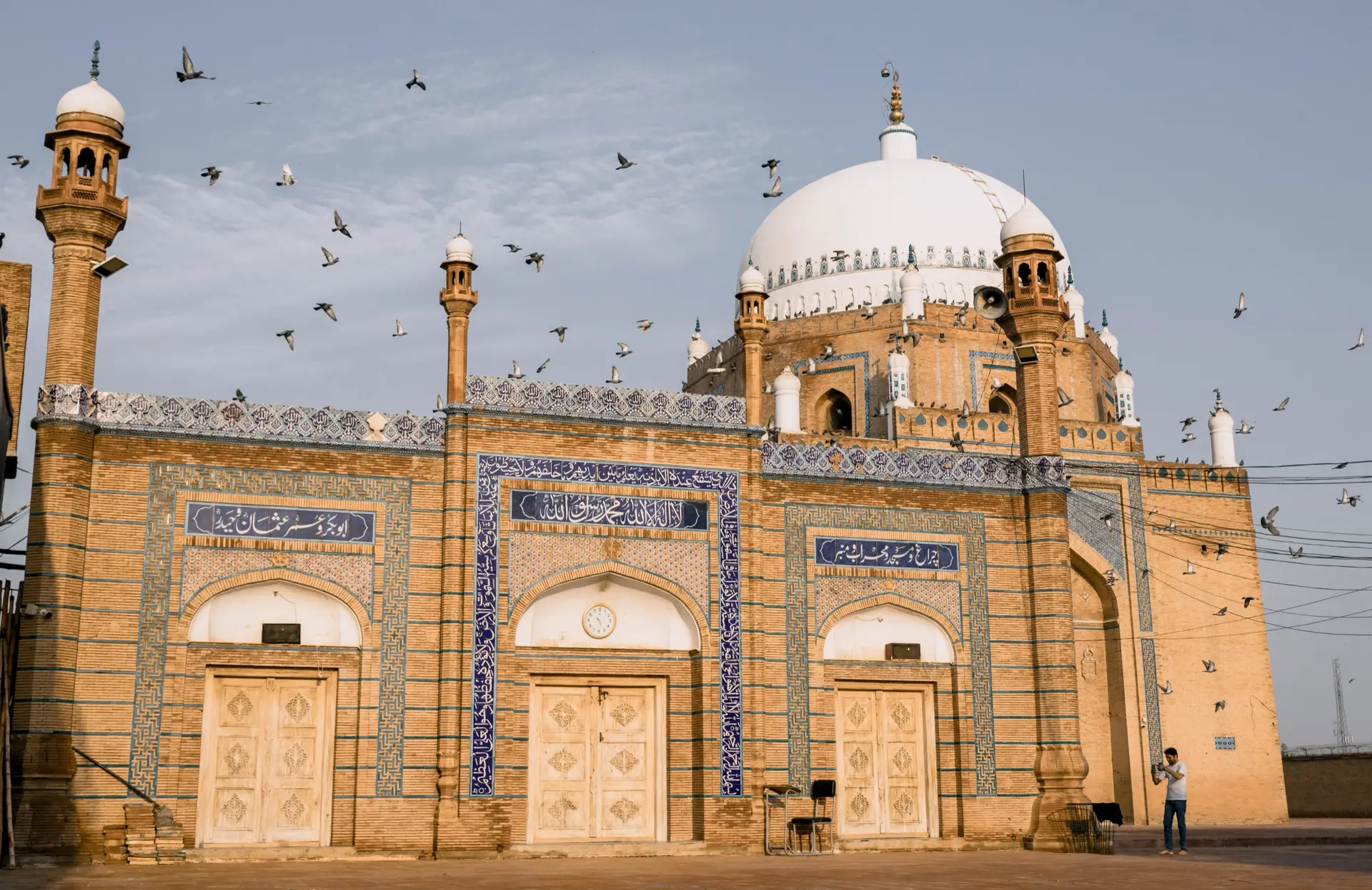
Go in the last hour of light. At noon the glaze on Shah Rukn-e-Alam does almost nothing and you'll wonder what the fuss is. Then the sun drops behind the old city and the whole octagon starts handing the light back. We've been up on that mound at three in the afternoon and again at six the same day. It isn't the same building.
Walk closer and it stops being architecture. Men asleep along the plinth where the wall throws shade, somebody tying a thread to a screen, a woman reading aloud to nobody. Not one of them is looking at the tiles, and that decides how your visit goes. Multan isn't a set of monuments with a city attached. It's a working devotional city that happens to hold the finest glazed-brick tombs in Pakistan, and you're a guest in somebody else's Thursday evening.
It's old past the point where dates help, among the longest continuously inhabited cities in South Asia, and the ground says so before any signboard does: the mound under the shrines is partly made of the Multans that came before. None of it is set up for visitors the way Lahore is. No ticket queues, no audio guides, almost no English signage, and outside your hotel lobby very few people who speak it.
The shrines, and which ones earn the time
Shah Rukn-e-Alam is the reason to come and there's no close second. It went up in the 1320s under the Tughlaqs, the earliest surviving work in that dynasty's style: an octagon of red brick braced with shisham beams, eight sloping towers taking the corners, glazed panels worked into the brick rather than pasted on. Give it an hour, and go twice, once in daylight and once after dark.
Bahauddin Zakariya is the older claim and the more important one historically. He died in the thirteenth century, brought the Suhrawardi order into this part of the world, and his tomb across the same mound is the prototype everything in southern Punjab copied. Plainer than Rukn-e-Alam and busier with devotees, which makes it the better place to sit still and the worse place to carry a camera.
Shah Shams, east of the mound beyond the old city, is the one we'd cut if you're short. The saint matters enormously; the building has been rebuilt so often that it reads far newer than the other two.
Shah Yusuf Gardezi is the one people miss and it's our favourite. Tucked into the lanes near Bohar Gate, off the top of Hussain Agahi, breaking the pattern entirely: no dome, a low flat-roofed box sheathed head to foot in blue and white floral tile, mirror-work inside. You'll walk past it twice.
The fort mound
The fort is a ruin, so know that going in. The British reduced it during the siege of 1848 and 1849, and what survives is a gate, stretches of outer wall and bastions holding up a public park, Qasim Bagh. There's no fort to tour. What you get is a raised platform in a flat city with the two great tombs on it. Come up at sunset.
The Prahladpuri temple site is up here as well. Be realistic: a ruin, nobody worshipping, very little to see. Go because it's a few steps off your route. Multan Museum nearby is small and quiet: coins, manuscripts, stone carving from before the Islamic period, a cabinet of Bahawalpur State stamps we liked more than expected. Forty minutes. Skip it if you're on one night.
The bazaars
Hussain Agahi is the oldest bazaar in the city and the one to walk. Block printing and hand embroidery in the fabric shops, a dry-fruit market called Gurh Mandi folded into the middle, and enough shrine traffic that it runs at a pace no covered market in Lahore matches. Sarafa is the gold market, worth it for the theatre. Chowk Bazaar is where the lanes knot together and where you'll get turned around. Go in the morning with no destination.
The crafts, and where they're actually made
The tilework has a name, kashi-kari, and it isn't a museum craft. It's still being fired, and the same tradition produces the blue pottery in every shop window. Understand the split. Most of what sells near the shrines is bought in or made fast for visitors; the workshops are clustered around the Daulat Gate side of the old city, and it's a workplace rather than a show. Best hour we've spent here that didn't involve a tomb.
The rest is real too. Camel-skin lamps are a genuine Multan speciality and the good ones are very good; bone work sits beside them and travels better. Khussa, the embroidered flat shoes, are made across southern Punjab and sold hard here, so try them on, because the cheap pairs take skin off. Ajrak and block-printed cotton belong more to the region running south towards Sindh. And sohan halwa, the sweet the city is known for, can end a tooth. Buy the plain one before the pistachio one.
How to behave at a shrine
Shoes off at the threshold; there's always somewhere to leave them. Cover shoulders and knees. Women should carry a scarf and put it on before going in, and both men and women should expect to be directed, sometimes firmly, towards separate areas: at the busier tombs the inner chamber has a women's side and a men's side. Don't walk between a praying person and the grave.
Thursday evening is when the city is most itself. Qawwali at the shrines and the dhamaal after it, drums and bodies and a crowd that gets dense fast. It's extraordinary and it isn't staged for you. Sit at the edge, stay a long time, and don't clap along until you can see that other people are.
On cameras: outside and at a distance, generally fine. Inside the burial chamber, no. People at prayer, no, and not without asking in a way that leaves room to refuse. The honest default is to keep the phone in your pocket.
Where to base yourself
Near the old city puts everything within walking distance, so you can go up the mound twice in a day without negotiating transport. Rooms are basic, street noise starts early, and it's the right call if the shrines are why you came. The Cantt is the compromise most people should take: quieter, better rooms, a short rickshaw hop in. Bosan Road has the newer hotels and the restaurants and is the least like Multan of the three. Fine for a business night, a waste of a short visit.
When to go
November to February. That's the window, and it isn't a soft recommendation.
Summer here is severe even measured against the rest of Punjab, and the day collapses under it: out early, retreat by ten, and the walk between two shrines becomes the only thing you achieve. Add the dust, and the shortage of anywhere cool to sit that isn't your own hotel. We've come in the wrong month. Winter days are warm and clear, the light on the tile is at its best, and the nights get properly cold.
Each of the big saints has an annual Urs marking his death, and the dates move every year because they follow the lunar calendar. Check before you book, since they cut both ways. Arrive during one and you'll see the shrines at maximum voltage, tens of thousands of pilgrims, drumming all night. You'll also be unable to move, unable to get a room, and unable to spend any quiet time with the buildings. Came for the architecture? Avoid it. Came for the city? Aim at it and forget the photographs.
Getting in and getting around
Multan International (MUX) takes domestic flights and a handful of Gulf routes, and unlike the airports up north it won't be closed by cloud. By road, the city sits on the motorway network, north towards Lahore and Islamabad, south towards Sukkur and eventually Karachi. By rail, Multan Cantt is on the main north-south line, which makes an overnight train a real option.
In the city, rickshaws. The old lanes are too narrow for a car in most places and a driver will drop you at the edge anyway, so take the rickshaw and agree the fare first. Distances are short.
How long to give it
A day and a half, and that's not a slight. Multan rewards depth rather than breadth, and there's no second tier of sights to fill a third day. Here's the shape we'd use. Arrive in the afternoon, go straight up the mound, spend the last of the light at Shah Rukn-e-Alam, walk down to Bahauddin Zakariya as the crowd builds. Next morning, into Hussain Agahi early, find Shah Yusuf Gardezi, get lost in the lanes, then the museum through the worst of the heat. Late afternoon, the workshops near Daulat Gate. Evening, back up the mound, and if it's a Thursday, stay.
It fits below Lahore on the 14-day route rather than replacing anything on it. If you're weighing up the south at all, read is Pakistan safe first.
Nearby
Lahore is north and the obvious pairing. Islamabad is further north again, and Karachi a long way south down the motorway.